Why Bigger Isn’t Better in Spray Drone Ground Systems
In the spray drone industry, there is a growing assumption that bigger ground systems automatically mean better performance. Taller trailers. Double decks. More tanks. More steel.
That assumption is wrong.
While some manufacturers are competing for physical footprint and airspace, Quantum Drone Systems designs for something far more important, access, safety, and return on investment. Most operators do not fail because their drone lacks capability. They fail because their ground systems slow them down, put crews at risk, or take too long to pay back.
The reality most operators face
Most professional spray drone operators are not spraying 10,000 acres in their first season. The majority are running 300 acres or less per day while they build contracts, crews, and confidence.
That operating reality changes the definition of efficiency.
When you are moving between small fields, irregular boundaries, tree lines, and rural roads, oversized double-deck systems create friction instead of speed. Operators lose time backing into fields, staging along dangerous roadways, and maneuvering rigs that were designed for open, industrial environments, not real farms.
Access beats capacity
Compact ground systems are not a compromise. They are a design choice.
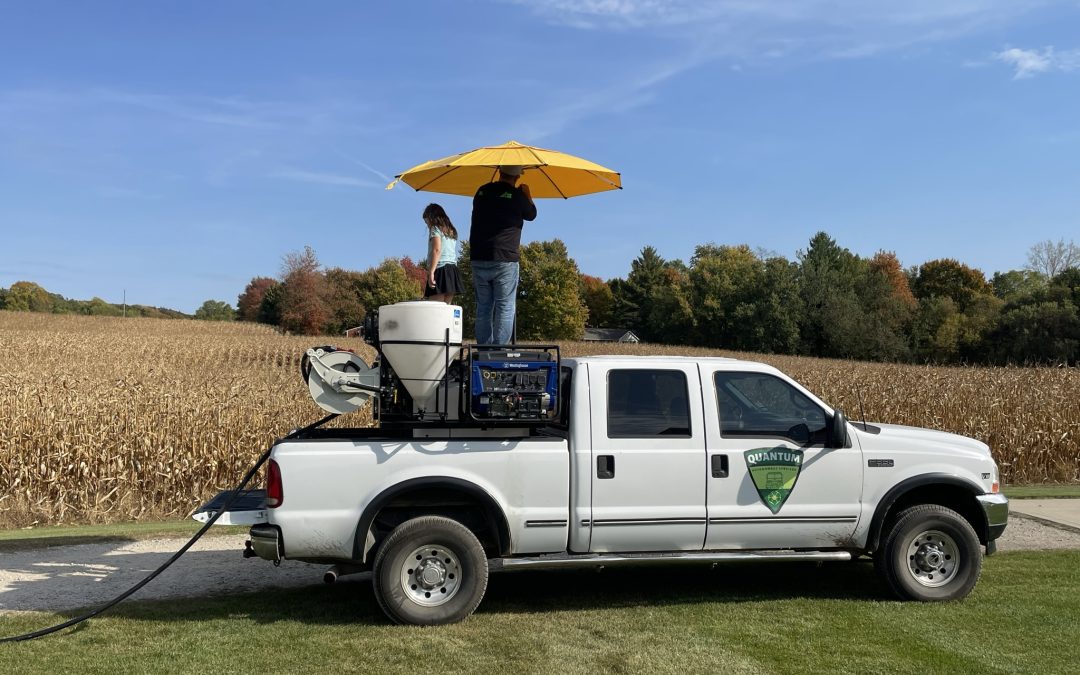
Smaller, mobile units allow operators to:
-
Get off narrow or high-traffic roads quickly
-
Access back corners of fields and irregular entry points
-
Avoid overhanging trees and obstacles
-
Stage closer to the spray zone, reducing transit time
-
Reduce risk when loading, mixing, and launching
Oversized double-deck systems often force crews to work from roadsides or open areas far from the field edge. That increases exposure, increases risk, and costs time on every load cycle.
Protecting the most expensive asset
Many large double-deck designs store drones on upper platforms. That creates two problems.
First, drones are exposed to branches, wind, and debris during staging and transport. Second, elevated handling increases the risk of drops, tip-overs, and operator injury.
Compact systems keep drones lower, more protected, and easier to handle. That matters when you are working long days, in heat, dust, and uneven terrain. Protecting the aircraft protects uptime, insurance costs, and crew safety.
Faster ROI matters more than theoretical scale
Ground systems are capital investments. For most operators, payback speed matters more than maximum theoretical throughput.
Compact systems:
-
Cost less upfront
-
Deploy faster
-
Require less crew complexity
-
Generate revenue sooner
Most operators will not reach multi-crew, high-acreage scale in year one or two. Designing around massive capacity before the business is ready increases financial risk. A nimble system with quick ROI lets operators grow at the pace of their contracts, not their debt.
Designed to grow as technology changes
Drone platforms evolve quickly. Payloads increase. Batteries change. Workflows improve.
Operators should not be locked into ground systems that only make sense for one generation of aircraft. Compact, modular systems adapt more easily as technology shifts, allowing operators to upgrade components without replacing entire rigs.
That flexibility is critical for long-term viability.
The Quantum Drone Systems approach
Quantum Drone Systems does not design for edge cases. We design for how operators actually work.
Our niche focus is operators covering 300 acres or less per day, because that is where most successful spray drone businesses begin. While our systems can support larger operations, compact platforms deliver advantages that oversized systems cannot, safer access, faster setup, lower risk, and quicker payback.
In spray drone operations, bigger is not better. Better is better.
And better starts on the ground.