The Lesson I Learned the Hard Way About Drone Trailer & Tender Systems
By Mike Byrne
I’ve been around the agricultural drone space since 2020.
My first real exposure came through Solvi, where I worked as an account manager helping agricultural clients understand, use, and interpret aerial imagery and crop analytics. That work put me close to the early stages of how drones, data, and agriculture were beginning to come together in practical ways.
At the time, a lot of the conversation was still focused on mapping, analytics, stand counts, crop health, and what drone data could tell growers and agronomists.
But then the application side started to move fast.
Spray drones were no longer just an interesting idea. Farmers, retailers, service providers, and custom applicators were starting to look seriously at drones as real tools for real work. That’s when I began spending more time with the people who were jumping into drone application early.
After my time at Solvi, I worked with a number of early drone applicators and operators who were trying to figure out what this business could become. That’s where I met a lot of guys who were helping shape the space before it became what it is today.
Everyone was learning.
Everyone was testing.
Everyone was trying to figure out what worked, what didn’t, and what the actual business model looked like once you got past the excitement of the drone itself.
And that’s one of the biggest lessons I’ve learned in this industry.
The drone matters, but the operation around the drone matters just as much.
From Selling the Idea to Running the Operation
Before joining Quantum Drone Systems, I co-founded and helped run Kingdom Crop Spraying in Frisco, Texas, with my close friend and business partner, Zec.
We built the business around real application work in North Texas, north of Dallas. Our jobs were pasture, rangeland, and rural properties where access was often the biggest challenge.
Like a lot of operators, we went into it with enthusiasm, experience, and a pretty clear idea of what we thought we needed.
And then the field taught us the rest.
Even after spending years around the drone industry, talking with operators, and cautioning new applicators about overbuilding too early, I made the same mistake I had warned other people about.
We bought the big trailer … a 32-foot setup.
On paper, it made sense. Big capacity. Lots of room. Professional looking. Everything in one place.
In reality, for the work we were doing, it was often the wrong tool.
Bigger Isn’t Always Better
In North Texas pasture and rangeland work, access is everything.
You’re not always pulling into clean farmyards, wide-open pads, or perfect field entrances. You’re dealing with gates, soft ground, uneven terrain, narrow access points, washed-out areas, back corners of properties, and roads that were never designed for a long trailer.
That big trailer looked impressive, but it created problems.
We got stuck.
We lost time.
We had to reposition more than we wanted.
We had to think too much about where we could park, how we could turn around, and whether we could even get the rig close enough to the work.
And when you’re trying to run a drone application business, every one of those little delays compounds.
The drone may be ready.
The pilot may be ready.
The customer may be ready.
But if your ground setup is fighting you all day, your productivity takes a hit.
That was the lesson.
Not every job needs a massive tender system.
Not every operator needs to start with a big trailer.
And not every impressive-looking setup is the right setup for the work you’re actually doing.
The Tiny Tender Changed How I Looked at the Job
Eventually, we sold the big trailer and bought our first Tiny Tender from Quantum Drone Systems.
That changed how I looked at drone operations.
The Tiny Tender wasn’t trying to be the biggest system on the market. That wasn’t the point.
It was practical.
It was mobile.
It fit the kind of jobs we were actually doing.
It gave us a cleaner way to handle mixing, water, chemical, drone transport, and field workflow without dragging around more equipment than the job required.
That experience stuck with me because it confirmed something I already believed but had temporarily ignored.
You need the right tool for the right job.
Not the biggest tool.
Not the flashiest tool.
Not the one that looks best in a parking lot.
The one that helps you get in, get set up, get the work done, and get out without turning the support equipment into the bottleneck.
A Personal Turn
Kingdom Crop Spraying was moving in the right direction, but life has a way of changing plans.
Zec was diagnosed with cancer, and that changed everything.
When something like that happens, the business conversation becomes secondary. Priorities shift fast. We made the decision to sell Kingdom Crop Spraying after a couple of successful years serving customers in North Texas.
It wasn’t the ending we had planned, but I’m proud of what we built, the work we did, and the lessons we took from it.
One of those lessons was simple.
Drone application is not just about flying drones.
It’s about building a field operation that actually works.
Why I’m Working with Quantum Drone Systems
Today, I work with Michael Vanderkolk at Quantum Drone Systems.
That relationship makes sense to me because I’ve been on the other side of this. I’ve sold into this market. I’ve worked with early applicators. I’ve helped operators think through the business. And I’ve personally dealt with the frustration of having the wrong ground setup for the work in front of me.
Quantum Drone Systems is focused on the part of drone operations that doesn’t always get enough attention.
The ground operation.
Mixing.
Refilling.
Battery handling.
Mobility.
Transport.
Setup and teardown.
Access.
The stuff that determines whether a day runs smoothly or turns into a long, frustrating grind.
That’s why I believe in the product lineup.
It gives operators options.
A smaller operator doesn’t need to start with a giant trailer.
A pasture or rangeland operator may need mobility more than maximum capacity.
A farmer doing his own work may need something simple, compact, and practical.
A custom applicator may need a bigger system, but still needs to think carefully about access, workflow, and the kinds of jobs they’re actually taking.
There isn’t one perfect tender system for every operator.
There’s the right system for your work.
The Mistake I See New Operators Make
A lot of new drone applicators start by focusing almost entirely on the drone.
Which drone should I buy?
How many batteries do I need?
What charger should I get?
How many acres per hour can I cover?
Those are all fair questions.
But they’re not the whole picture.
The better questions are:
What kind of jobs am I actually going after?
How far will I be from water?
How tight is the field access?
Am I working pasture, row crop, specialty crop, food plots, forestry, or mixed work?
Will I be operating alone or with a crew?
Do I need to move fast between small jobs?
Am I trying to build a full-time application business or support my own farm?
How much equipment can I realistically pull, park, manage, and pay for?
That’s where the right tender system becomes critical.
Because the support setup needs to match the business model.
If it doesn’t, you feel it immediately.
You feel it in wasted time.
You feel it in setup delays.
You feel it when you can’t get close to the job.
You feel it when you’re stuck, literally and financially, with more equipment than your operation needs.
My Advice to New Applicators
Don’t buy the dream setup.
Buy the setup that matches the work you’re most likely to do.
There’s nothing wrong with a larger trailer or high-capacity tender system when the job calls for it. For some operators, that’s exactly the right move.
But don’t assume bigger means better.
Bigger can mean slower.
Bigger can mean harder to move.
Bigger can mean more cost before the revenue is there to support it.
Bigger can mean you’re solving problems you don’t actually have yet, while creating new ones you didn’t expect.
Start with the work.
Then choose the equipment.
That’s the order I wish more people followed.
Right Tool, Right Job
The drone industry has grown up a lot since I first entered the space in 2020.
The conversations are better now. The operators are more experienced. The equipment is improving. The business models are becoming more realistic.
But one thing hasn’t changed.
The field will tell you the truth.
It’ll tell you whether your equipment is helping or hurting.
It’ll tell you whether your setup is practical.
It’ll tell you whether you built an operation around real work or around a picture in your head.
I learned that lesson the hard way.
That’s why I believe so strongly in matching operators with the right ground infrastructure for the jobs they actually do.
For some, that might be a compact UTV-based setup.
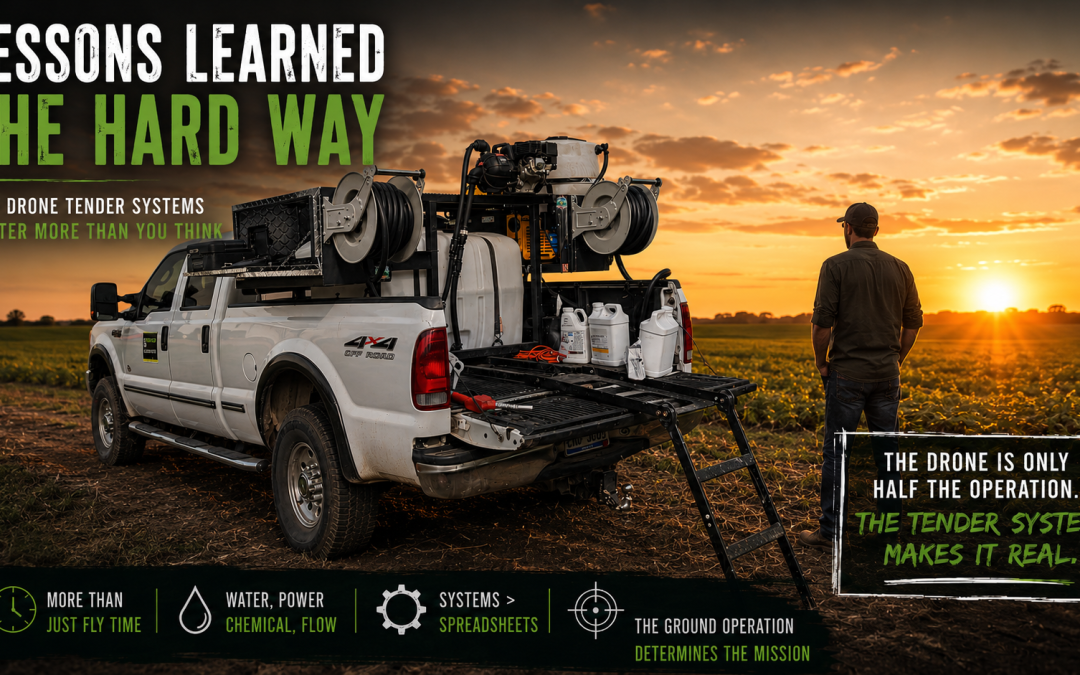
For others, it might be a truck-mounted tender.
For larger operators, it may be a trailer or flatbed system.
The point isn’t to sell everyone the same thing.
The point is to help operators avoid the mistake I made, and get into a setup that makes their days easier, not harder.
Because in drone application, success isn’t just about what’s in the air.
It’s about everything that supports it on the ground.
Can you send me more info on your truck set up